
Gyratory crushers are workhorses in the mining and aggregate industries, capable of handling massive volumes of rock and reducing them to smaller, more manageable sizes. But what makes these behemoths tick? Understanding the crushing principles behind them is key to appreciating their power and efficiency. This post dives into the mechanics of gyratory crushers, explaining how they achieve such impressive reduction.
At its core, a gyratory crusher's operation hinges on a conical crushing head rotating eccentrically within a stationary concave crushing chamber. This seemingly simple design gives rise to a surprisingly complex crushing process. Imagine a large cone spinning slightly off-center within a larger, fixed cone. The space between these two cones forms the crushing zone.
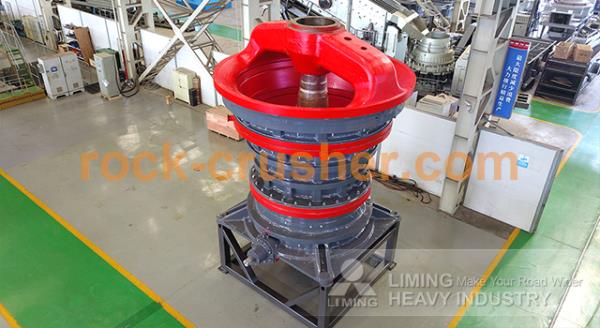
The crushing action itself is a combination of compression and shearing. As the crushing head rotates, material fed into the top of the crusher is trapped between the rotating cone and the concave mantle. The eccentric rotation gradually forces the rock inwards towards the crushing zone, where the converging surfaces apply immense compressive forces. This squeezing action begins the size reduction.
Simultaneously, the shearing forces play a crucial role. The material isn't just squeezed; it's also subjected to significant shearing stresses as it's being pushed and pulled by the rotating cone. These shearing forces contribute significantly to the fragmentation process, leading to more efficient size reduction compared to pure compression-based methods.
Several factors influence the effectiveness of this crushing mechanism:
* Eccentricity: The degree of off-center rotation of the crushing head directly impacts the crushing force. A greater eccentricity leads to a more aggressive crushing action.
* Cone angle: The angle of the crushing cone influences the particle trajectory and the overall crushing efficiency. A steeper angle generally leads to a more aggressive crushing action but might also increase wear on the crushing surfaces.
* Speed of rotation: The speed at which the head rotates affects both the throughput and the fineness of the product. Slower speeds may produce a more uniform product, while higher speeds increase throughput but might result in less precise size control.
* Crushing head and mantle materials: The selection of materials for the crushing head and mantle is critical. They must possess high wear resistance to withstand the extreme pressures and abrasive forces involved. Common materials include manganese steel and high-chromium cast iron.
* Material properties: The characteristics of the material being crushed, such as hardness, toughness, and fracture behavior, directly influence the crushing process and efficiency. Harder and tougher materials require more energy and may lead to increased wear on the crusher components.
The resulting crushed material is discharged from the bottom of the crusher, usually through a discharge opening whose size can be adjusted to control the final product size.
Gyratory crushers are highly versatile, capable of handling a wide range of materials and producing a variety of particle sizes. Their robust design makes them ideal for primary crushing applications, where large rocks are reduced to a smaller size before further processing. Understanding the principles outlined above allows for better optimization of these machines, leading to increased efficiency, reduced wear, and ultimately, lower operating costs.