
In the world of mining and aggregate production, crushers are indispensable pieces of equipment that help in reducing the size of large rocks, ores, and other materials for further processing. One type of crusher that plays a crucial role in this process is the gyratory crusher. In this article, we will explore the significance of understanding gyratory crusher product size and its impact on overall operational efficiency.
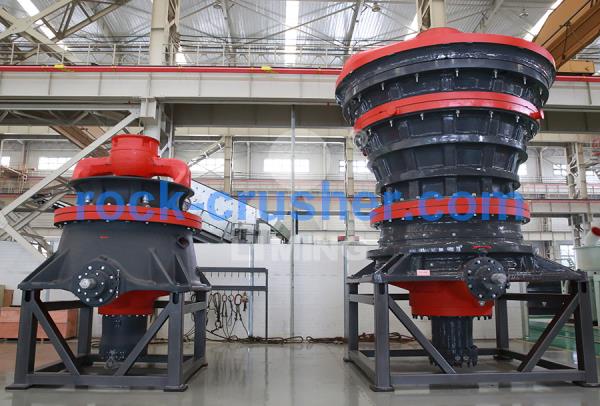
What is a Gyratory Crusher?
A gyratory crusher is a primary crusher widely used in mines and quarries. It consists of a concave surface and a conical head, both of which are typically lined with manganese steel. The inner cone has a slight circular movement, allowing the materials to be crushed by the continuous compression between the concave and the mantle.
Significance of Gyratory Crusher Product Size:
1. Optimal Crusher Performance:
The product size of a gyratory crusher directly affects its performance and efficiency. By controlling the product size, operators can ensure that the crusher is operating within its designed capacity and producing the desired output. Properly sized material allows for smoother operation, reduced wear and tear, and improved energy efficiency.
2. Influence on Downstream Processes:
The product size of a gyratory crusher has a significant impact on the subsequent stages of the crushing circuit. If the product size is too coarse, it may cause difficulties in downstream processing, such as inefficient grinding in ball mills or poor separation in mineral processing equipment. On the other hand, if the product size is too fine, it can lead to overgrinding and excessive production of fines, which may result in reduced overall processing efficiency.
3. Balancing Production and Quality:
Achieving an appropriate product size is crucial for striking the right balance between production quantity and quality. While larger product sizes might result in higher production rates, they may sacrifice the desired product quality. Conversely, smaller product sizes could improve the quality but may limit the processing capacity. Therefore, finding the optimum product size ensures the ideal compromise between both factors.
Factors Affecting Gyratory Crusher Product Size:
1. Closed-Side Setting (CSS):
The CSS is the minimum distance between the concave and the mantle. Adjusting the CSS allows operators to control the product size by regulating the crusher's intake and discharge openings. A smaller CSS results in a finer product size, while a larger CSS produces a coarser product.
2. Feed Material Characteristics:
The properties of the feed material, such as hardness, abrasiveness, and moisture content, have a direct impact on the product size. Harder materials require more energy to be crushed, potentially resulting in a coarser product, whereas softer materials can be crushed more easily, producing a finer product.
3. Crushing Chamber Design:
The shape of the crushing chamber also influences the product size. Chambers with a flatter profile tend to produce a finer product, while those with a steeper profile produce a coarser product.
Understanding gyratory crusher product size is vital for optimizing crusher performance and achieving efficient downstream processing. By controlling factors like the closed-side setting, feed material characteristics, and crushing chamber design, operators can produce the desired product size that strikes the right balance between production rates and quality.
Furthermore, in-depth knowledge of gyratory crusher product size allows mining and aggregate operators to fine-tune their processes and maximize productivity while minimizing energy consumption and operational costs.