
Rock crushers are essential pieces of machinery used to break down rocks into smaller, more manageable sizes. These powerful devices are often seen in mining and construction sites, where they play a vital role in producing high-quality aggregate materials. In this article, we will delve into the inner workings of rock crushers, exploring how they operate and why they are an integral part of the crushing process.
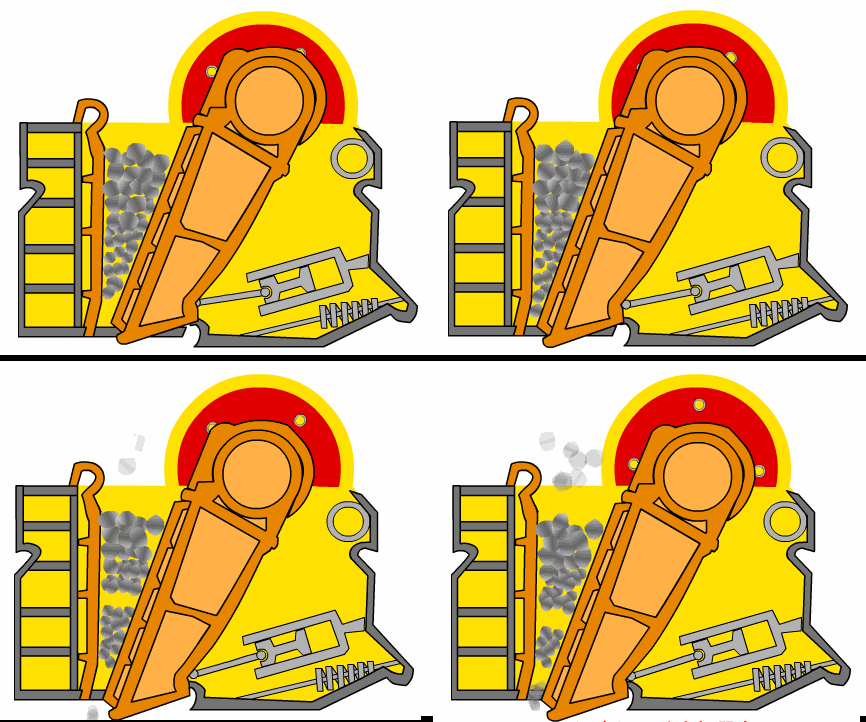
1. Crushing principles:
Rock crushers rely on mechanical force to break down large rocks into smaller, more manageable pieces. This process occurs in stages, as rocks are fed into the crusher and gradually transformed into smaller fragments. Two fundamental crushing principles underpin the operation of rock crushers:
a) Impact crushing: In this method, rocks are caught between two surfaces - a fixed and a moving one. As the rocks are impacted by the moving surface, they are shattered into smaller pieces.
b) Compression crushing: This principle involves applying pressure to break rocks apart. The rocks are squeezed between two surfaces - typically, a stationary plate and a movable plate. The pressure exerted gradually crushes the rocks into smaller sizes.
2. Components of a rock crusher:
Rock crushers consist of various components that work together to efficiently crush rocks. These include:
a) Feeders: As the name suggests, feeders facilitate the continuous and regulated flow of rocks into the crushing chamber.
b) Crushing chamber: This is the heart of a rock crusher. It comprises a fixed jaw plate and a moving jaw plate, which exert the necessary force to compress or impact the rocks.
c) Drive unit: The drive unit powers the movement of the crushing chamber, either through an electric motor or hydraulic system, ensuring the efficient operation of the crusher.
d) Conveyor belts: These belts transport the crushed rocks from the crusher to the designated storage area, or directly to a subsequent processing stage.
3. Types of rock crushers:
There are different types of rock crushers, each designed to suit specific crushing needs. Some common types include:
a) Jaw crushers: These crushers have a fixed jaw plate and a movable jaw plate, enabling strong compression crushing of rocks.
b) Cone crushers: Cone crushers are used for secondary or tertiary crushing. They operate by squeezing rocks between an eccentrically rotating mantle and a stationary concave.
c) Impact crushers: Impact crushers utilize the principle of impact crushing to break down rocks. They can be divided into horizontal impact crushers and vertical shaft impact crushers.
4. Importance of rock crushers:
Rock crushers are pivotal in various industries due to their ability to produce high-quality aggregate materials. Some key reasons why these machines are of utmost importance include:
a) Efficient utilization of materials: Rock crushers break down larger rocks into smaller, more uniform sizes of aggregate material, making them easier to transport and use in various construction projects.
b) Cost-effectiveness: By crushing rocks on-site, construction companies save resources and reduce transportation costs associated with hauling aggregate from distant quarries.
c) Versatility: With a range of different crushers available, different types of rocks can be processed efficiently, meeting diverse industry needs.
Rock crushers play a crucial role in efficiently breaking down rocks into smaller, more manageable sizes. Understanding the principles behind their operation, as well as the components and types available, is vital for those working in mining, construction, or any industry that relies on high-quality aggregate materials. By harnessing their power, industries can utilize these machines to enhance productivity while reducing costs and environmental impact.