
Rocks are essential raw materials in various industries, including construction, mining, and manufacturing. To obtain different sizes of rocks suitable for different purposes, they must undergo a crushing process. One of the critical machines that enable crushing is a crusher. Crushers come in different types, but all serve the same purpose of breaking large rocks into smaller pieces. In this article, we will delve into how rocks are broken in crushers.
First, it is crucial to understand the types of crushers used in the crushing process. They include jaw crushers, cone crushers, impact crushers, and gyratory crushers. Each crusher type works differently and is suitable for specific types of materials.
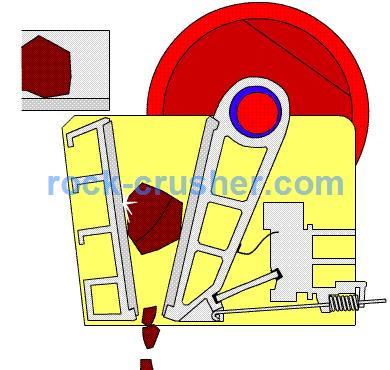
Jaw crushers are the most commonly used crushers when it comes to crushing rocks. They use a fixed jaw plate and a movable jaw plate to achieve the desired size reduction. Rocks are fed into the crusher through a feeder that regulates the feeding rate to ensure even crushing. The rocks are crushed as the movable jaw plate moves towards the fixed jaw plate, applying pressure on the rock until it breaks into smaller pieces.
Cone crushers work similarly to jaw crushers but have a different design. They have a cone-shaped mantle that rotates around a vertical shaft. As the mantle rotates, it crushes the rocks against the bowl liner until they break into smaller pieces. The size of the crushed material is regulated by the distance between the mantle and the bowl liner.
Impact crushers apply force using a high-speed rotating rotor with a hammer or blow bar that impacts the materials. Rocks that enter the crusher, hit the rotating rotor and are crushed due to the impact force. These crushers are suitable for crushing hard and brittle materials that cannot be easily crushed by other crushers.
Lastly, gyratory crushers work by compressing the material between two surfaces, the mantle, and the concave. The rocks are crushed as the mantle moves towards the concave, applying pressure until they break into smaller pieces. These crushers are suitable for crushing large rocks at high capacities.
Once the appropriate crusher has been selected, the rocks are fed into the machine and crushed using the method described for each crusher type. It is important to note that the size of the rocks must be appropriate for the crusher type used. This helps the machine operate efficiently and prolongs its lifespan.
In addition to selecting the appropriate crusher, the feeding process and the crushers' maintenance are also essential in ensuring efficient and effective crushing. A continuous, steady feeding rate ensures consistent crushing and prevents the crusher from becoming overloaded. Regular maintenance, such as changing the worn-out parts and lubricating the machine, prolongs the equipment's lifespan and ensures optimal performance.
Hence, rocks are broken in crushers, and the crushing process is essential in obtaining suitable sizes of rocks for different purposes. The type of crusher used largely depends on the material being crushed and the intended size reduction. Proper feeding and maintenance of the machines are crucial in ensuring efficient and effective crushing.