
When it comes to large-scale rock crushing, cone rock crushers play a vital role in various industries, particularly in mining, quarrying, and construction. These powerful machines are indispensable for reducing large rocks into manageable sizes for further processing or direct use. But what exactly are cone rock crushers, and how do they work? Let’s dive into an illustrated explanation to understand their design, function, and significance.
What is a Cone Rock Crusher?
A cone rock crusher is a type of crushing machine that uses a rotating cone inside a stationary bowl to crush rocks. The crushing chamber is shaped like a cone – hence the name. This crusher is generally used for medium to fine crushing of ores and rocks, producing uniform particles used for construction and industrial purposes.
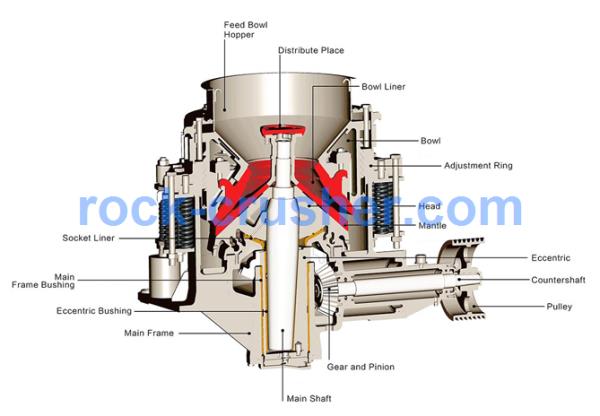
How Does a Cone Rock Crusher Work?
To visualize the operation, imagine a large, rotating cone inside a slightly larger cone-shaped chamber. The inner cone (known as the mantle) gyrates or spins eccentrically around the axis, while the outer cone (called the bowl liner) remains stationary. Rocks are fed into the top of the machine and are squeezed between the mantle and bowl liner as the mantle gyrates.
The crushing process includes:
- Feed Materials: Raw rocks are introduced to the top of the crusher.
- Compression & Crushing: The rotating mantle crushes the rocks against the fixed outer wall.
- Material Reduction: Crushed material becomes smaller and smaller until it falls through the gap between the mantle and the bowl liner.
- Discharge: The crushed rocks exit at the bottom of the crusher, ready for further processing or use.
Illustration Insight: Parts of a Cone Crusher
A typical cone crusher consists of several key parts that work in unison:
- Mantle: The moving part that gyrates, exerting compressive force.
- Bowl Liner: The fixed outer part against which the rocks are crushed.
- Eccentric Shaft: Drives the mantle’s gyrating movement.
- Feed Opening: Where raw material enters.
- Discharge Opening: Where crushed material exits.
Many illustrations highlight these components to help users understand how the crusher operates and how maintenance might be performed.
Types of Cone Crushers
There are several variations designed for different crushing needs:
- Standard Cone Crushers: For secondary crushing of medium-hard to hard materials.
- Short Head Cone Crushers: For finer crushing of harder materials.
- Symons Cone Crushers: Popular for their efficiency and wear resistance.
Why Are Cone Rock Crushers Important?
The uniform and precise crushing action of cone crushers allows for producing aggregates with consistent size, minimizing waste, and ensuring quality in construction projects. Additionally, their robust design allows for continuous operation under high pressure, making them reliable and efficient.
Maintenance Tips Illustrated
An illustrated guide often shows how to inspect the mantle and bowl liner for wear, check the eccentric shaft condition, and properly lubricate moving parts.
Illustrations of cone rock crushers serve as a powerful tool for understanding the crushing mechanisms and main components that make cone crushers effective in their role. Whether you’re a mining professional, engineer, or construction manager, knowing how these crushers operate helps in optimizing their use and maintaining them correctly.
Explore more about rock crushers, their varieties, and applications to improve your industrial or construction processes.